For the complete documentation index, see llms.txt. This page is also available as Markdown.

Searching for Assets

Finding the asset easy within your HIVO library. This guide explores HIVO's Library search functionalities, empowering you to locate any asset quickly and efficiently.

HIVO offers various search methods to meet the diverse needs of users in searching and managing digital assets. Below are the commonly used search methods:

Search using natural language queries and receive the most relevant results.

Find visually similar assets using image-based similarity search.

Search for text within PDF files and highlight matching terms in the search results.

Filter assets based on criteria such as file type, upload date, creator, tags, or custom metadata.

Quickly search using keywords in the asset name, description, tags, or metadata.

Search across the current folder and all child folders in Folder Mode.


Search Bar

  • Locate the Search Bar at the top of your library.

  • Enter a general keyword relevant to your desired asset. Keyword search results will be based on file name, tags, OCR tags, description, and metadata (fields belonging to metadata such as author, image caption prediction, etc.).

  • Press Enter to initiate the search. The search considers asset names, tags, and descriptions (case-insensitive).

Library general search
  • Click the "X" on the search term or use the Delete key to remove the keyword.

Remove Keyword

The Search Bar was specifically designed to deliver lightning fast search results in order to minimize the amount of time you spend searching for Assets. The general keyword search is performed against Asset names, tags, and the ‘description’ metadata field (case insensitive).


Natural Language Search & Match Score

The Natural Language Search feature allows users to enter search queries in a more conversational and intuitive way, without needing to remember exact keywords. Powered by Natural Language Processing (NLP), the system can understand the context of the query and return results that are more accurate and relevant.

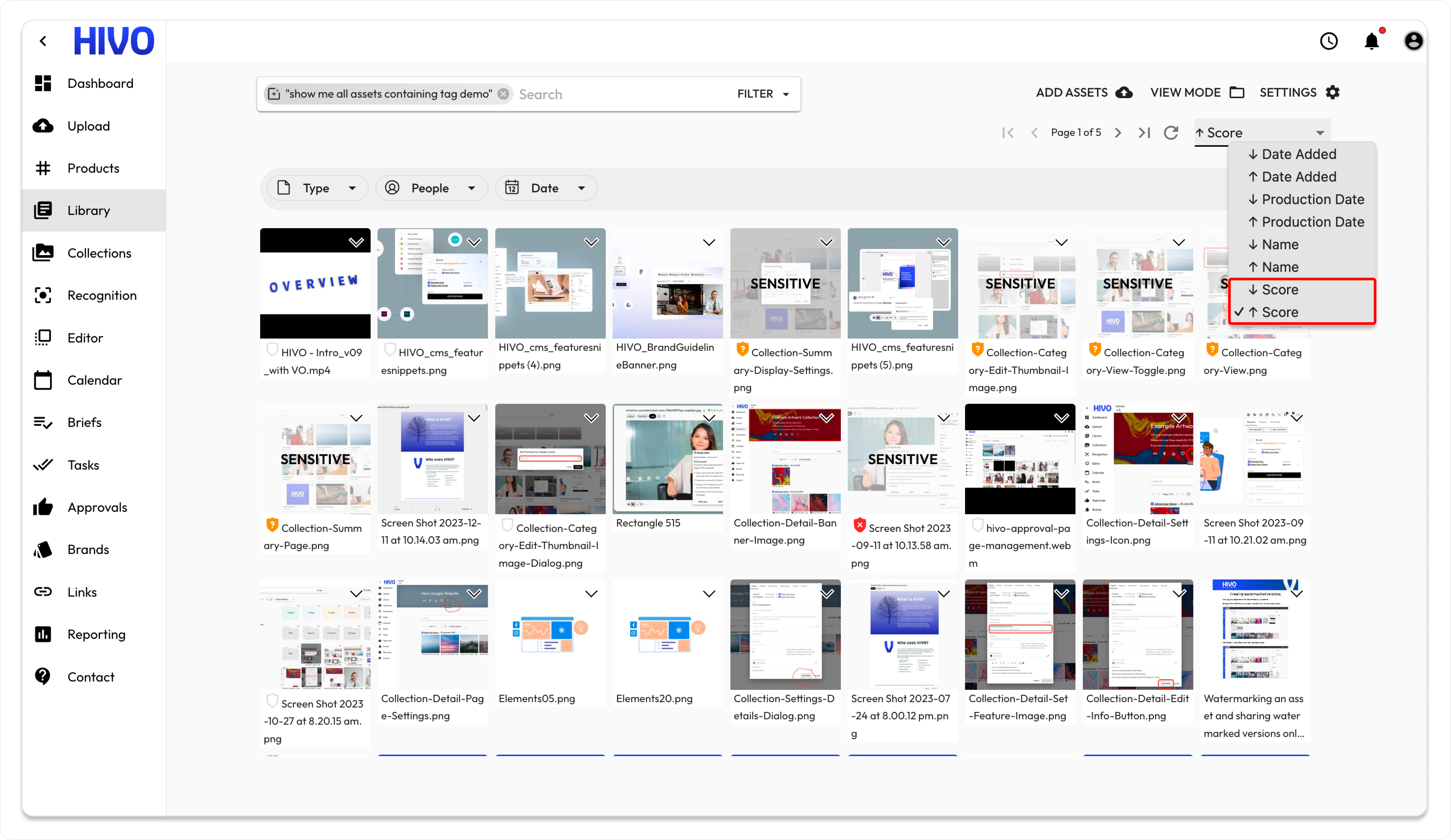
Users can also sort results by Match Score, helping them quickly identify which assets are most closely related to their search intent.

  • Access the Library and active Natural Language Search Mode: In the Search Bar, click the icon on the left side of the search bar to switch to Natural Language Search mode.

Natural Language Search
  • Enter a natural, descriptive query in the search bar, for example: “Show all images that contain Jane Smith”

Enter a natural, descriptive
  • Press Enter to run the search. The system automatically analyzes and interprets the context of your query to return results that best match the meaning of what you're looking for.

Natural Language Search

🔹 Step 2: Sort by Match Score

  • After running a search, go to the results displayed in the Library.

  • Use the Sort menu located at the top right corner of the interface to sort results by:

    • Highest Match Score

    • Lowest Match Score

Sorting by Match Score helps you quickly find the most relevant assets, especially when your query returns a large number of results or is more descriptive in nature.

Sorting by Match Score

AI Visual Search

Visual Search is an intelligent search feature within the HIVO Library that allows users to quickly discover assets based on their visual semantics and vector embeddings. This includes overall shape, composition, dominant colours, and abstract characteristics like texture. This feature leverages advanced image analysis and vector embedding technology to determine the degree of similarity between assets.

🔹 Step 1: Search by images/asset

  • Access the Library and activate Find Similar Mode: In the Search Bar, click the icon on the right side of the search bar to switch to "Find Similar" mode.

Find Similar
  • Select a Base Asset: Select an existing asset in your library, computer, or browser URL that you want to use as the basis for your search.

Find similar Image
  • Press Enter to run the search. The system will analyze the content, characteristics, and metadata of the selected asset to suggest visually and contextually similar assets.

Find

🔹 Step 2: Adjust Similarity Level

After receiving results, you can refine the similarity by using the available slider or options:

  • Increase Similarity: To view assets that are nearly identical or highly similar.

  • Decrease Similarity: To broaden the scope and find more related assets that share characteristics but may not be exact matches.


Search Filters

Search Filters are another way to quickly find Assets saved within your Library, and can be used for more specific searches. Search Filters can be used in combination with general keyword searches, or by themselves.

To add a Search Filter, click the down arrow on the Search bar, and select a filter that you would like to apply.

Library search Filter

Search Filters include:

Types
Description

Favourites

Displays all Assets that you have Favourited in your Library.

Archived/Sensitive

Focus on archived or sensitive assets.

Approval

Choose whether you want to filter by only Approved/Unapproved Assets.

Type

Filter by the Asset file type category (image, video, document or audio).

Collection

Filter by Assets contained within the given Collection.

Task

Filter by Assets that have been added to the given Task.

User

Filter by Assets uploaded by the given User.

Tag

Assets containing the given tag.

Date

Select a ‘added from’ or ‘produced from’ date range

Location

Assets that have their location equal to the given value.

Metadata

Filter by Assets containing a given metadata name:value pair. E.g. Author: John Doe.

Colour

Filters for Assets that have a large degree of similarity to the given colour. This may be useful when creating themed brand content.

Face Detection

Search by face size and/or by a given person. See: Recognition.

Note: "Production date" is an optional field on Assets; if an Asset doesn’t contain this field and this ‘produced from’ filter is being used, it will be filtered.

You can combine multiple Search Filters for more accurate results. In the below example, a date filter is used in conjunction with a tag and user filter.

Combine multiple search filters

PDF Search Feature

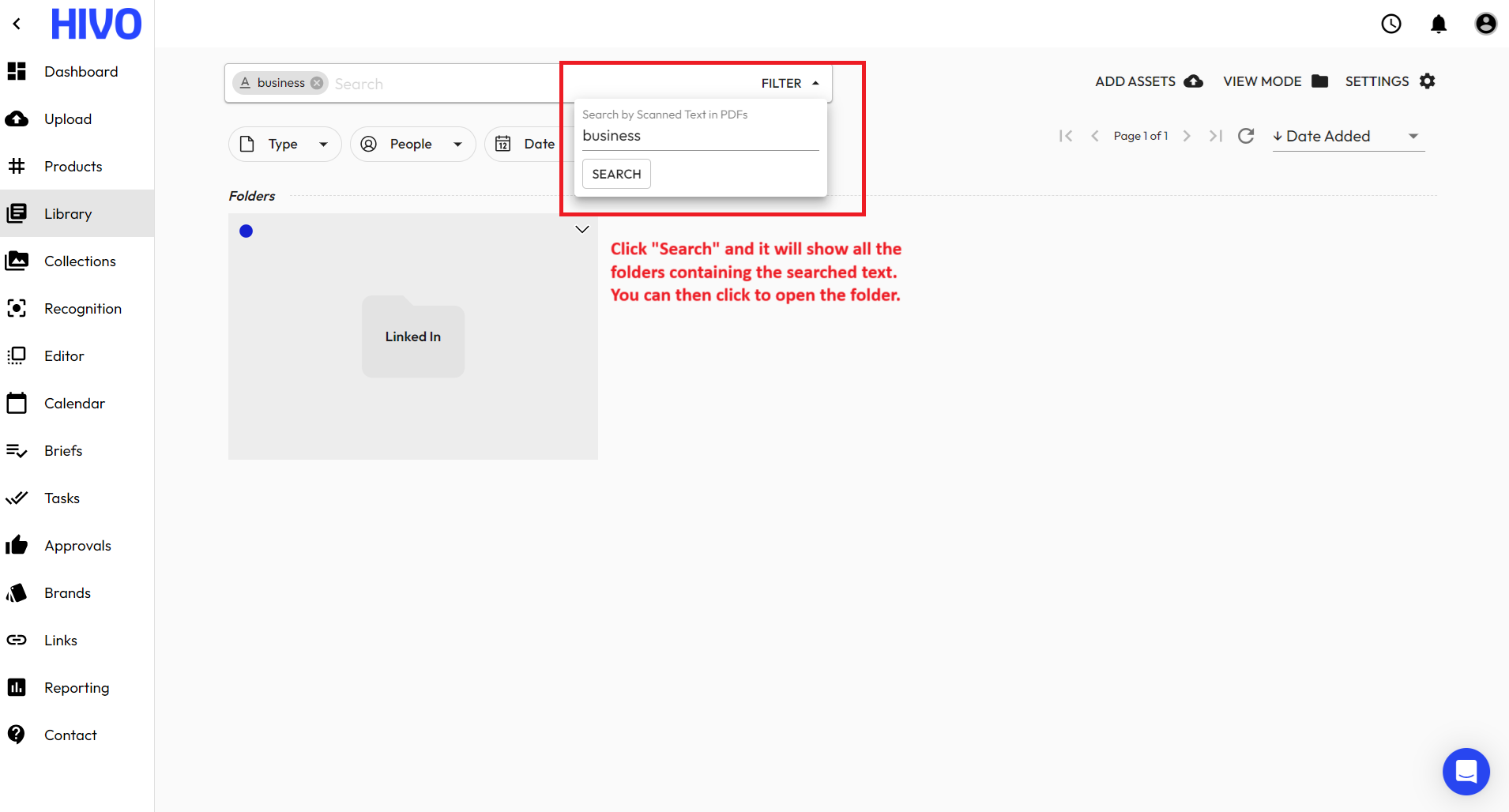
Allows users to find specific text within PDF files stored in the Library. It shows results that help users locate files containing the searched term and highlights that term within the files for easy viewing.

Note: Always ensure to tick the “Scan PDF Contents” checkbox when uploading a PDF file. If you don't, the content of your file won't be scanned. As a result, any phrases within the file will not appear in the search results.

Scan PDF Contents

1. Search Text in PDF's from the Library

  • Go to the Library: Navigate to the library section of your HIVO account, found in the main menu on the right side.

Library
  • Enter Keyword: In the search bar, type the specific keyword or phrase you want to find for accurate results. You can filter to "PDF Text" for more precise results.

Filter - PDF Text
  • Click Search: Click the search button to initiate the search.

  • View Results: The system will return a list of all files containing the searched text.

2. Find PDF Text Search Results in Library and then Open the PDF on the Asset Detail Page

  • Select a PDF File: After performing a library pdf search, a list of files containing the searched term will be displayed. Browse through the list and click on the file you wish to view in asset detail page.

  • Automatic Scrolling: The view will automatically scroll to the first page containing the searched term.

  • Highlighted Text: The searched text will be highlighted in the PDF.

3. Search the text in a PDF from the Asset Detail Page

  • Open the Asset Detail View: Navigate to and open the "View Asset Detail" screen where the selected PDF file is displayed.

  • Begin Searching: Locate and click on the search icon, within the "Asset Detail View" screen. This will open a search input field.

  • Enter Search Term: In the search input field, type the term you want to find within the PDF file. Press the Enter key on your keyboard to initiate the search.

  • Locate and Highlight the Term: Similar to the Library search, the system will now locate the first occurrence of the searched term within the PDF. The searched term will be highlighted for quick identification.

  • Automatically Go to the Relevant Page: The view will automatically scroll or navigate to the first page where the searched term appears, ensuring you can easily find the relevant content within the document.


Deep Asset Research

Previously, when searching in Folder Mode, the results only displayed the folders that contained matching assets. Users had to open each folder individually to find the exact asset they needed.

With Deep Asset Search, HIVO automatically searches through the entire subfolder tree and displays result both Folders and Assets on a single screen. This minimizes manual steps and saves significant time when working with large folder structures.

When searching in Folder Mode, matching folders and assets are both shown on the same screen folders first, then assets with clear “Folder Search Results” and “Asset Search Results” labels.

🔹 How to Use

  • Step 1: Open Folder Mode Navigate to the Library, then switch to Folder Mode or Tree View mode.

  • Step 2: Enter your keywords into the Search bar. You can search by Asset Name, Tags, Metadata, etc.

The system will automatically search within the current folder and all child folders, eliminating the need to open each folder to check manually as before.

🔹 Search Results Display

After performing a search, the results will be grouped into two sections on the same screen:

  • Folder Search Results: Displays the folders containing assets that match your search keywords You can quickly preview the folder containing the results and navigate directly to the exact location of the asset.

  • Asset Search Results: Located right beneath the folder section is the list of matching assets. This list displays assets found within both the current folder and all child folders. You can open, preview, or perform actions on these assets as usual.

If you have any questions, don't hesitate to ask, we're always here to help!

Last updated