> For the complete documentation index, see [llms.txt](https://support.hivo.co/llms.txt). Markdown versions of documentation pages are available by appending `.md` to page URLs; this page is available as [Markdown](https://support.hivo.co/~/changes/eaCuYFhybbREuBouwZp6/assets/sharing-assets.md).
# Sharing Assets
### Shared Links
A selection of Assets can be shared externally from HIVO using Shared Links. Shared Links offer options to:
* Enter a description for the usage/reason. This will only be viewable within the shared Asset’s Detail page on HIVO (and thus not anyone external).
* Set an expiry for the link. When this is reached, the link will no longer show any Assets. It’s recommended to set shorter expiry dates so that your Assets remain private.
* Expose the metadata contained within any of the Assets in the link.
* Allow feedback (comments) on Assets inside the link.
* Limit the versions that are shared from the link. E.g. you may have a watermarked Asset with un-watermarked ‘Original’ versions that you don’t want to share.
*Note: Any modifications made to Assets will carry over to the Shared Links they’re in.*
You can create shared links for Assets in the Library by select the images => click the 3 dots icon in the top right => Share option. This will open up a popup with the link options.
Create shared link
To view existing links that an Asset exists in, click into the [Asset's detail page](/~/changes/eaCuYFhybbREuBouwZp6/assets/asset-detail-page.md) and navigate the 'Share' tab (chain icon). Click the 'Shared Links' option, and then the 'existing links' tab. This tab will let you view the details of the link, get the URL, and delete it.
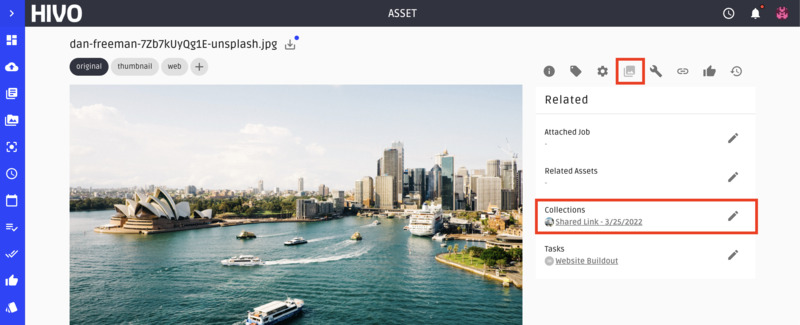
Note: if multiple Assets are shared at once, then a shared Collection is generated instead - so the link won't be visible directly on the Asset through the steps mentioned above. Shared collections generated this way can be seen in the 'Related' tab, as entries labeled with 'Shared Link - (date)'. You can click the pencil icon to remove the Asset from the shared collection, or click the link to enter the collection, where you'll be able to delete the entire shared collection by clicking the three dots icon => remove tab.
Shared link Asset Collection
### Nudge Asset
Other Users within HIVO can be [Notified](/~/changes/eaCuYFhybbREuBouwZp6/notifications.md) about an Asset by Nudging it to them.
If you want to notify another User about an Asset, you can ‘Nudge’ it to them with an optional message. Multiple Assets can be selected and Nudged at once using [Library Actions](/~/changes/eaCuYFhybbREuBouwZp6/library/library-actions.md), or you can select the ‘Nudge Users’ option inside the sharing tab of the Asset Detail page. If a User is Nudged an Asset that they don’t have at least ‘Can View’ permission on, they won’t be able to view it.
Nudge asset
---
# Agent Instructions
This documentation is published with GitBook. GitBook is the documentation platform designed so that both humans and AI agents can read, navigate, and reason over technical content effectively. Learn more at gitbook.com.
## Querying This Documentation
If you need additional information that is not directly available in this page, you can query the documentation dynamically by asking a question.
Perform an HTTP GET request on the current page URL with the `ask` query parameter, and the optional `goal` query parameter:
```
GET https://support.hivo.co/~/changes/eaCuYFhybbREuBouwZp6/assets/sharing-assets.md?ask=&goal=
```
`ask` is the immediate question: it should be specific, self-contained, and written in natural language.
`goal` is optional and describes the broader end goal you are ultimately trying to accomplish on behalf of the user. GitBook uses it to tailor the answer towards what is most useful for that goal.
The response will contain a direct answer to the question and relevant excerpts and sources from the documentation.
Use this mechanism when the answer is not explicitly present in the current page, you need clarification or additional context, or you want to retrieve related documentation sections.