> For the complete documentation index, see [llms.txt](https://support.hivo.co/llms.txt). Markdown versions of documentation pages are available by appending `.md` to page URLs; this page is available as [Markdown](https://support.hivo.co/video/video-transcription.md).
# Video Transcription
Automatically generate video/audio scripts quickly
The **Video Transcription** feature in HIVO automatically generates written transcripts from your **video or audio assets** using AI-powered speech recognition.
👉 This automation helps teams quickly **extract and organize** spoken content for easy review, reference, and download of transcripts for reuse across multiple projects.
**💡 Key Benefits:**
* ***Save time and effort:** No need to manually type or transcribe content.*
* ***Enhance accessibility:** Provide captions or text versions for hearing-impaired users.*
* ***Support multilingual workflows:** Automatically detect and transcribe in the spoken language.*
* ***Enable cross-team collaboration:** Marketing, content, and compliance teams can easily reference transcripted materials*.
## How to Generate Video Transcription
HIVO provides you to "**Generate Transcript for video/audio asset”** in two ways:
* **For assets already stored in the librarys:** Run the transcription process on assets already stored in your library.
* **When uploading new asset:** Generate transcripts automatically when uploading a new asset.
### 1. Generate Transcript for **assets already stored in the library**
#### **🔹 Step 1: Open** Generate transcripts feature
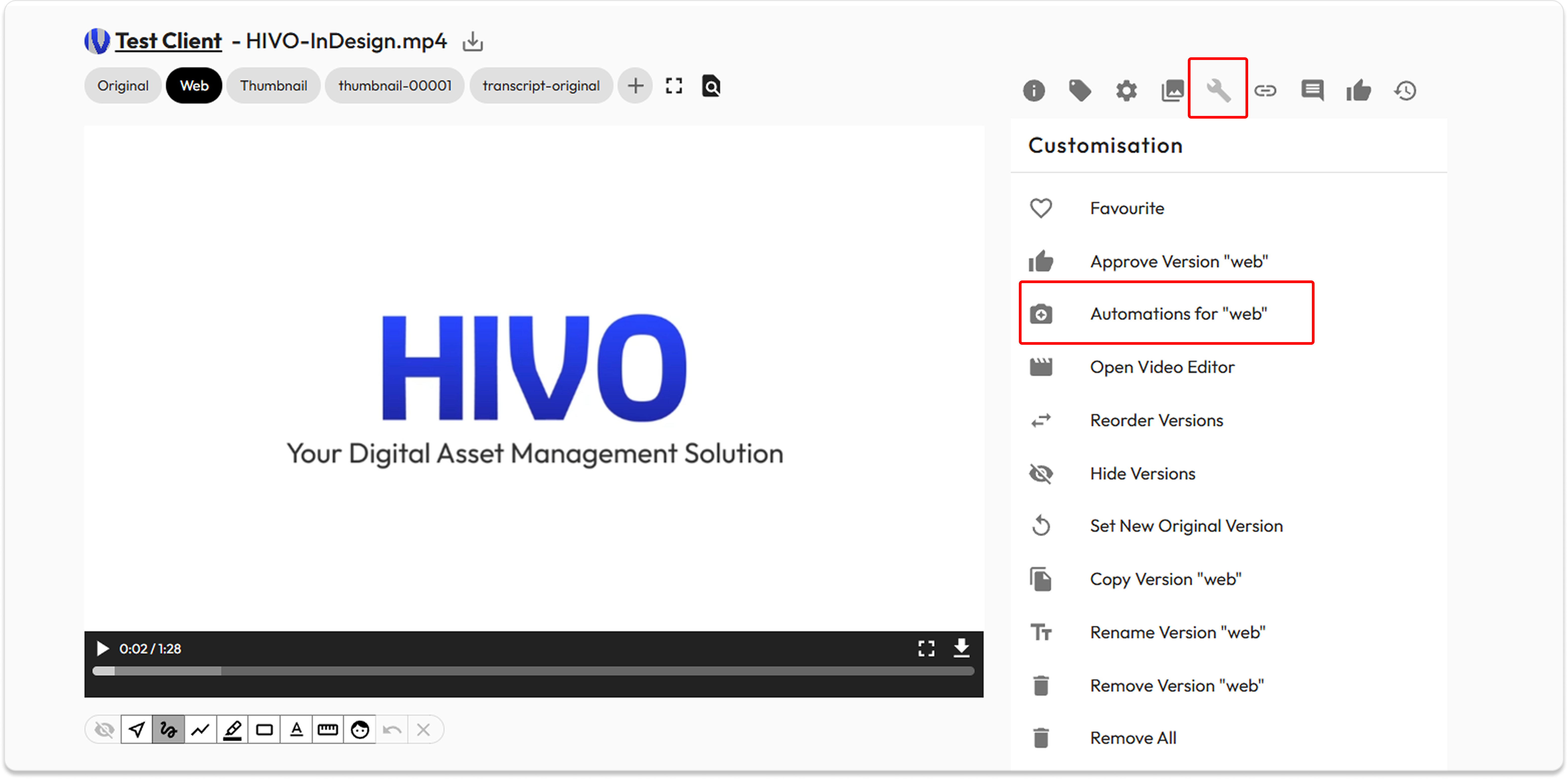
* Go to the **Asset Detail Page**.
* On the **Asset Action Toolbar**, select **“Customization.”**
* In the dropdown, choose **“Automations for original/web/thumbnail”** (Note: choose the correct version to check).
#### **🔹 Step 2: Run the Transcription**
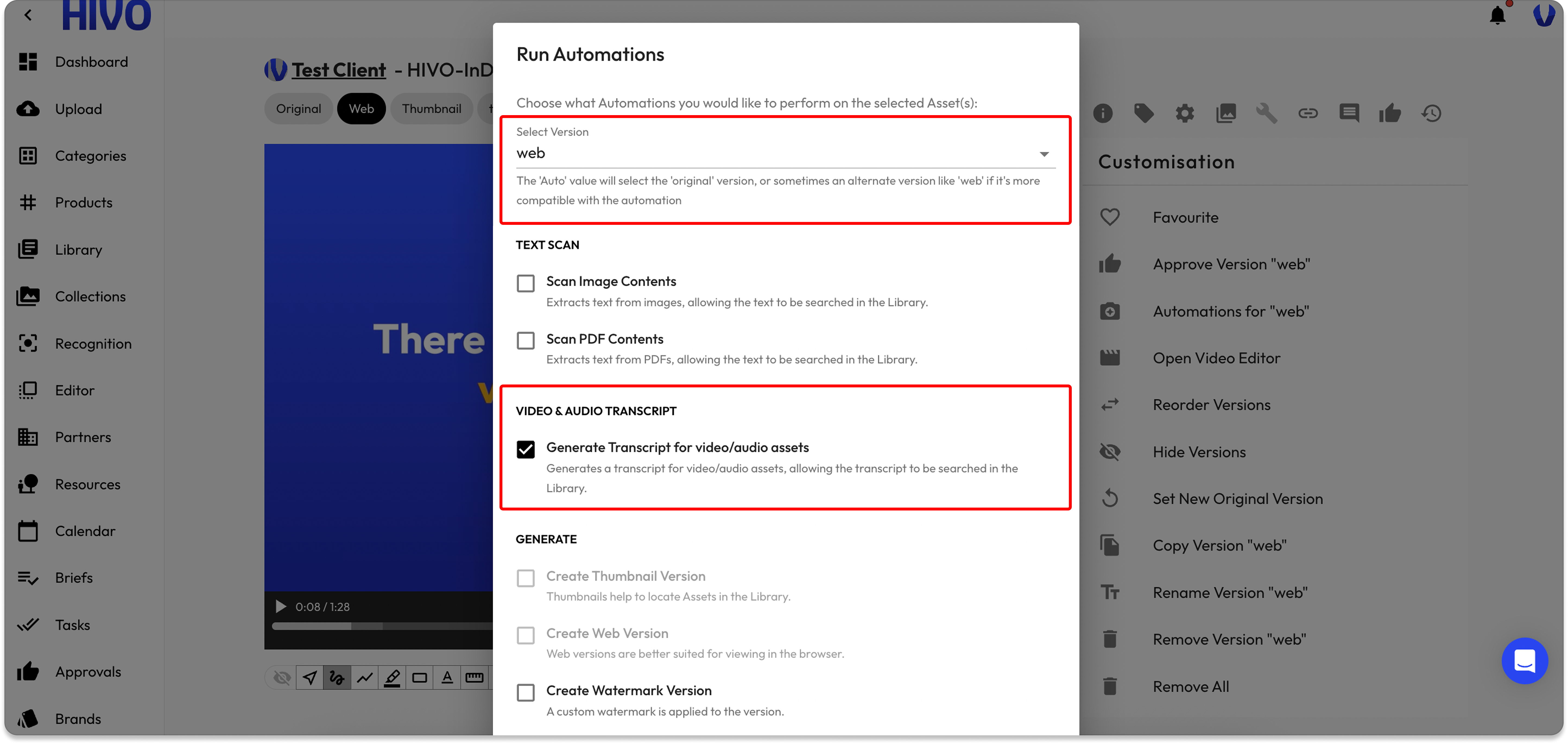
* In the new dialog, tick the checkbox **“Generate Transcript for video/audio assets.”**
* Click **Submit** to start the process.
* Once completed, a success message will appear at the top-right corner of the screen.
#### **🔹 Step 3:** View and manage Transcription Results
* After receiving the completion notification, close the pop-up.
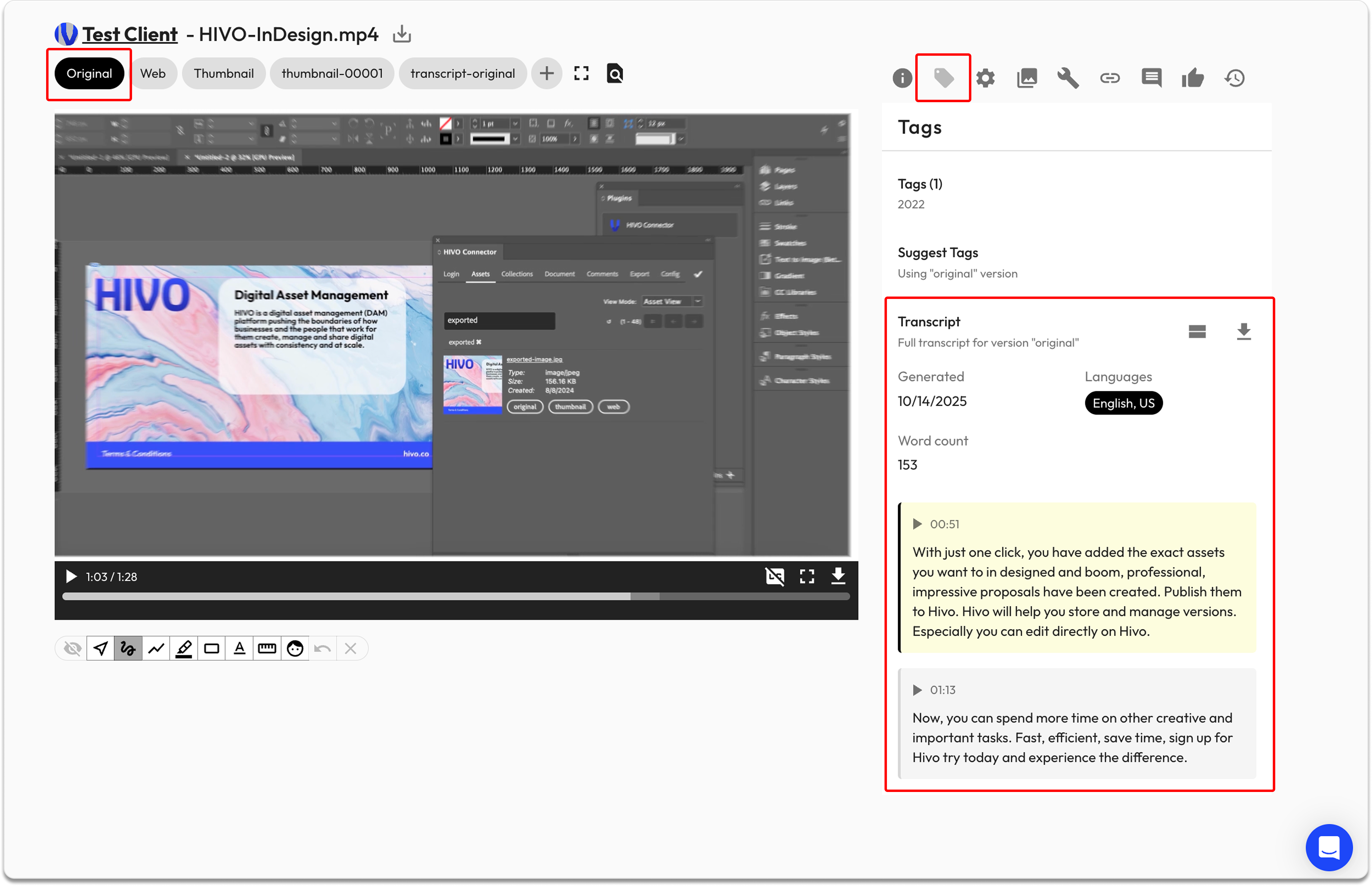
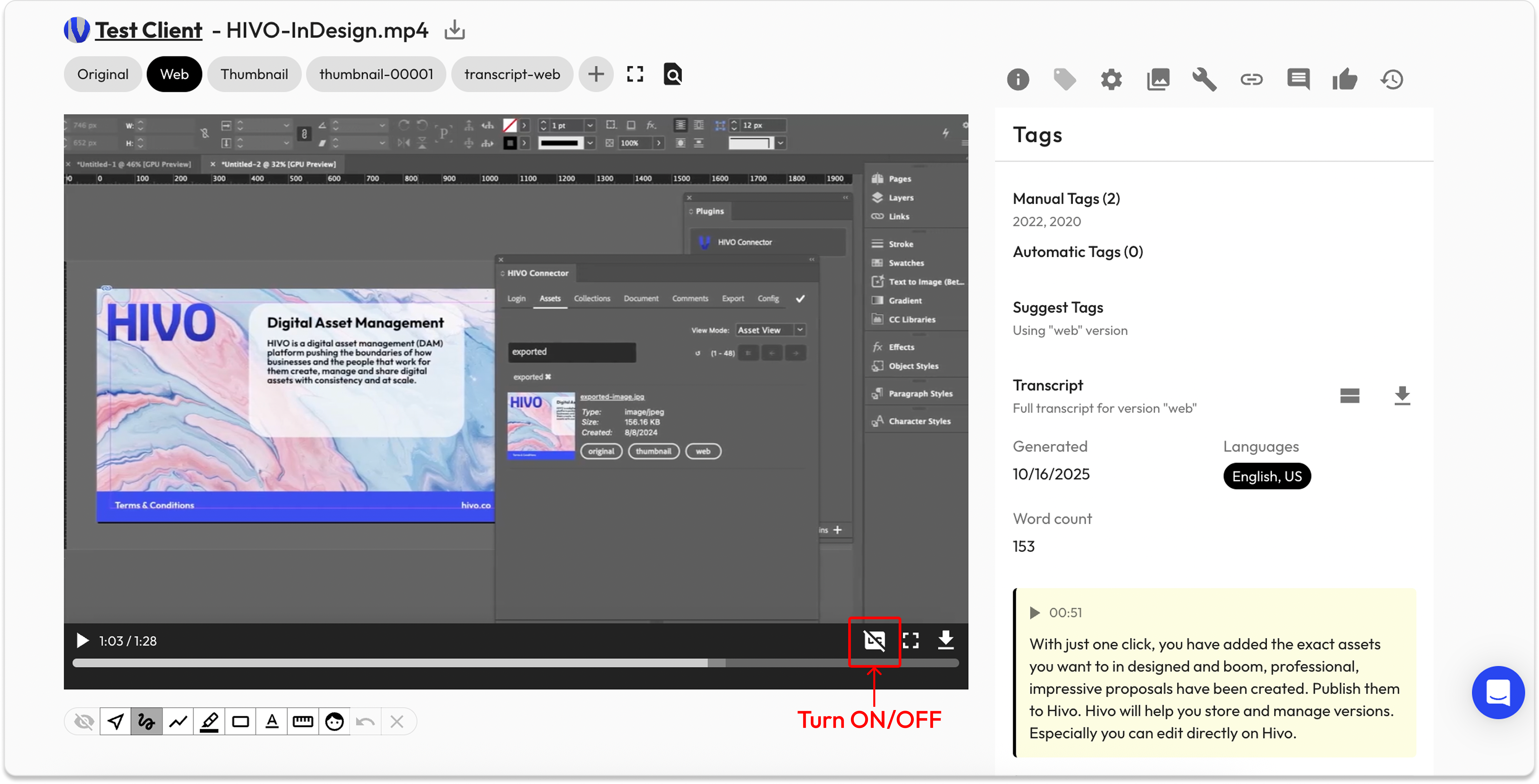
* Go to the **Tags tab** on the **Asset Detail Page** (Note: choose the correct version of the script created).
👉 The **Transcription Result** will include:
* **Generated Time:** Timestamp of transcript creation.
* **Detected Language:** The language automatically recognized by the system.
* **View Modes:**
* **Segment View:** Displays transcript by time segments.
* **Paragraph View:** Displays transcript as continuous text.
* **Download Options:**
* **SRT File**
* **VTT File**
* **TXT File**
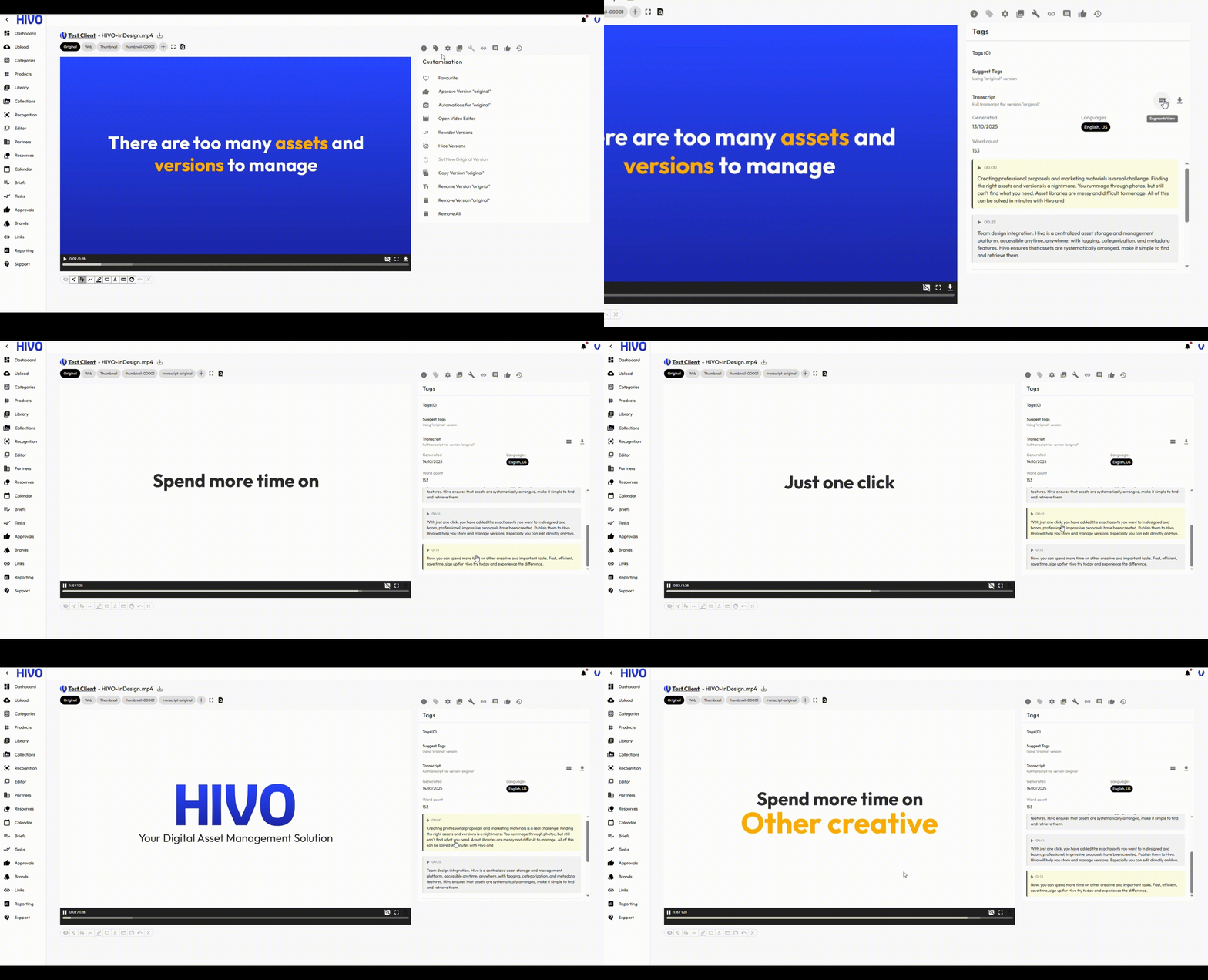
* Click on any transcript line to **jump to the corresponding timestamp** in the video.
#### 👉 Turn ON/OFF Video Subtitles
* Click the CC icon to enable the automatically generated subtitles (captions). Click it again to disable them.
* Note: If the subtitles do not appear, ensure you have completed Step 3 (View and manage Transcription Results) to create the SRT/VTT file (the system will automatically recognize and display the subtitles if the SRT/VTT file is attached).
### 2. Generate Transcript During the Upload Process
⚠️ Users with the permission ***'Is Client Admin - User can manage the Client Profile'*** can add Automation options within the [**Uploader Settings**](/client-profile/client-profile-settings/asset-and-metadata-management/uploader-settings.md)**.**
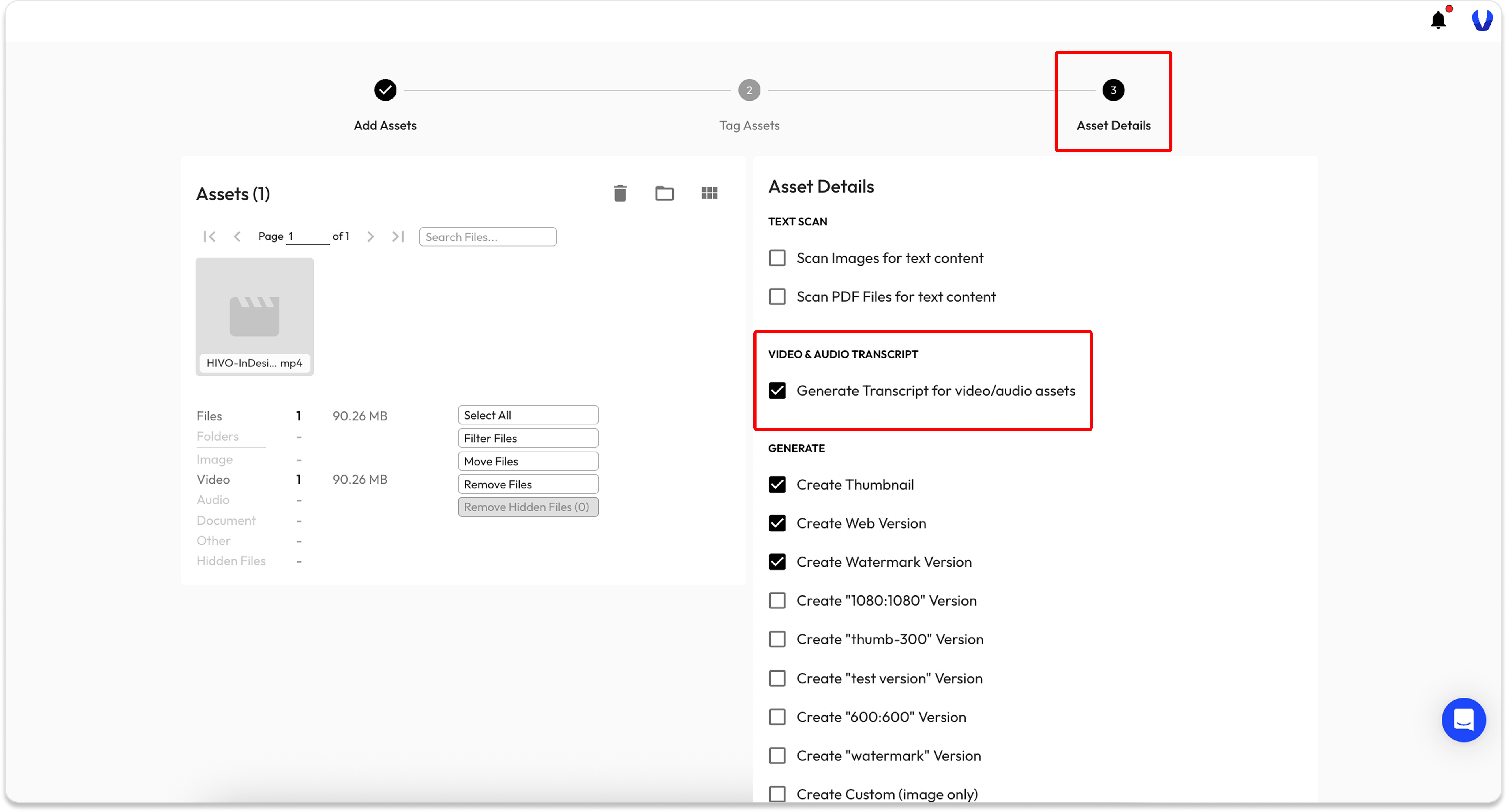
* Go to the **“Asset Detail”** step in the upload procesprocess, Scroll down to the **“Additional Automations”** section.
* Tick the checkbox **“Generate Transcript for video/audio assets.”**
* **Continue uploading as usual** — HIVO will automatically process it and you can **view the results once the asset has been successfully uploaded**.
* View and manage Transcription results: At this point, the asset is stored in the librarlibrary, go to the **Asset Detail Page** and navigate to the **"Tags tab"** to see the results.
👉 **👉 Note**: **For assets in the Approval stage** (The Assets need to be reviewed and approved by Users with ***'Can Approve'*** permission before being added to the main Library):
* Results will not be displayed immediately.
* Once the asset is approved and officially stored on the HIVO Library, go to the **Asset Detail Page** and navigate to the **"Tags tab"** to see the results.
## How to Edit Video Transcripts
This feature allows you to easily review and refine inaccurate words or sentences generated by AI without having to regenerate the entire transcript.
Note: The video must have successfully generated a transcript.
#### **🔹** Step 1: Navigate to Transcript
* Go to the Asset Detail page of the video.
* Switch to the Tags tab and scroll down to the **Transcript section.**
#### **🔹** Step 2: Enable & Make Edits mode
* Switch on Edit mode.
* The transcript is organized into time-stamped segments matching the video.
* Click directly on any text segment you want to adjust and type in your corrections.
#### **🔹** Step 3: Save your updates to complete the process
#### Automatic Synchronization (Auto-Sync)
Once saved, your edits will automatically sync across the entire platform, updating:
* The transcript text displayed in the Tags tab.
* On-screen video subtitles and captions.
* Downloadable transcript files.
* Both Original and Web versions of the transcript.
Easily proofread AI-generated output, improve subtitle accuracy, and ensure consistent content across all versions.
If you have any questions, don't hesitate to ask, we're always here to help!
---
# Agent Instructions
This documentation is published with GitBook. GitBook is the documentation platform designed so that both humans and AI agents can read, navigate, and reason over technical content effectively. Learn more at gitbook.com.
## Querying This Documentation
If you need additional information that is not directly available in this page, you can query the documentation by asking a question.
Perform an HTTP GET request on the following URL with the `ask` and `goal` query parameters:
```
GET https://support.hivo.co/video/video-transcription.md?ask=&goal=
```
`ask` is the immediate question: it should be specific, self-contained, and written in natural language.
`goal` is what the user is ultimately trying to achieve, the reason they need the answer. Sharing it helps GitBook give you a better, more relevant answer. A goal is most helpful when it describes the outcome the user wants rather than restating the question. For example, with `ask=how do I create an API token`, a goal like `automate deployments from our CI pipeline` lets GitBook tailor the answer to that use case.
The response will contain a direct answer to the question and relevant excerpts and sources from the documentation.
Use this mechanism when the answer is not explicitly present in the current page, you need clarification or additional context, or you want to retrieve related documentation sections.
.png?alt=media&token=651b2c97-32ce-41c6-afd4-41b086f0e6ab)
